


We pointed an AI agent at a macOS dataset and let it hunt for about six minutes. It mapped six Macs from scratch, found all three intrusions we’d planted, and wrote down what it learned. Then we ran it again on the same data.
The second run opened with one query to check whether anything had changed since the first hunt. Nothing had. So it skipped the work it had already done, spent its six minutes on questions the first run never reached, and came back with two detection rules that return only the malware.
None of the data was real. No Mac ever produced a single event in it, and nothing in it ever executed. Fake data plus an agent with a memory is what we brought to Objective by the Sea this year. This is the longer version, including the parts we didn’t have time for on stage.
Data no Mac ever produced
Practicing macOS hunting has always meant choosing between two bad options.
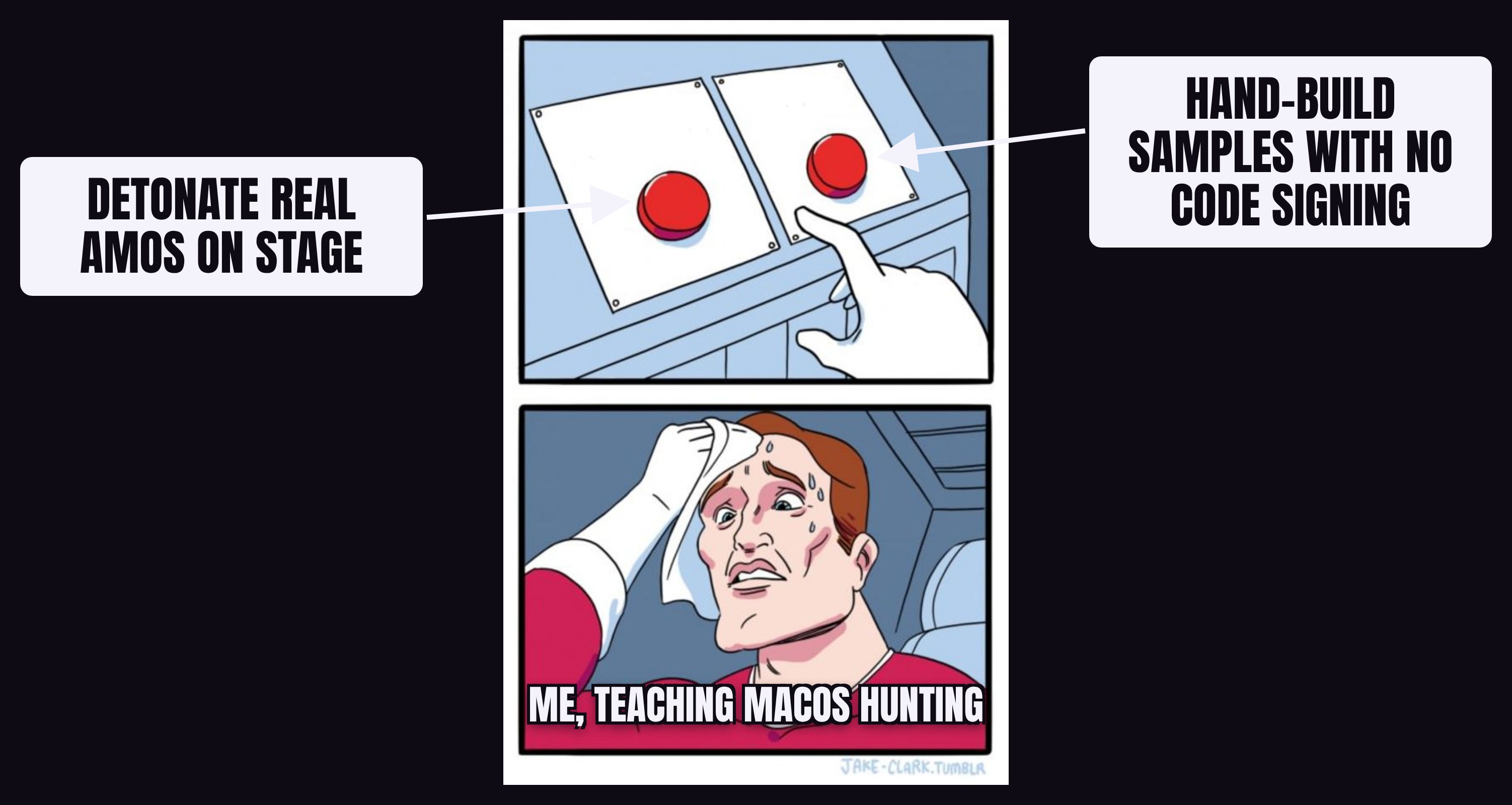
Real malware is dangerous to hand out and never runs the same way twice. Hand-built samples are safe, but they skip the fields that matter. No signing_id, no team_id, no BTM launch item events, and process trees that stop two levels up.
So we used Cisco Talos’s EvidenceForge, extended through a THOR Collective collaboration with Talos to emit macOS Endpoint Security (ESF) events. Here’s a record from our dataset:
{ "event_type": 9,
  "event": { "exec": { "target": {
    "audit_token": { "pid": 86221, "euid": 501 },
    "ppid": 1,
    "signing_id": "CleanMyMacX Helper",
    "team_id": null,
    "is_platform_binary": false,
    "codesigning_flags": 536870915,
    "path": "/Applications/CleanMyMacX…"
  } } } }
That’s the AMOS dropper starting on a host called MAC-DESIGN-01. ppid 1 means launchd started it, the way a double-click does, and euid 501 is an ordinary user. The codesigning flags, 0x20000003, add up to signed plus valid plus ad-hoc. team_id is null and it isn’t a platform binary. Nobody put their name on this thing.
At OBTS we asked the room which of these two came off a real Mac.
Record A:
{ "event_type": 9,
  "target": {
    "signing_id": "com.hnc.Discord",
    "team_id": "53Q6R32WPB",
    "codesigning_flags": 570508049,
    "audit_token": { "euid": 501 },
    "ppid": 1 } }
Record B:
{ "event_type": 9,
  "target": {
    "signing_id": "com.google.Chrome",
    "team_id": "EQHXZ8M8AV",
    "codesigning_flags": 536949505,
    "audit_token": { "euid": 501 },
    "ppid": 1 } }
A is Discord, captured with eslogger on Sydney’s Mac (macOS 26.6) while we prepped the talk. B is Chrome on MAC-DESIGN-01, which doesn’t exist. If you can’t tell them apart, neither can your agent, and that’s what makes the data worth hunting on.
The same scenario, seed, output formats, and EvidenceForge version always give you the same dataset. There are no LLM calls at generation time, nothing executes (EvidenceForge models the activity and renders the evidence it would leave), and every bundle ships an answer key, GROUND_TRUTH.md and GROUND_TRUTH.json, which the agent never saw. EvidenceForge also writes Zeek logs for the same hosts on the same clock. Endpoint Security has no TCP connect event, so you join the two on host IP and time, and that join is how “an unsigned app opened the keychain” becomes “and then 2.45 MB left.”
One practical warning before the hunt. Real eslogger escapes forward slashes and doesn’t keep JSON keys in a fixed order, and EvidenceForge copies both habits. When we grepped the raw file on MAC-IT-01 for /Users/Shared, it came back empty, and jq found the CloudMensis helper sitting right there. Give your agent a JSON parser. A regex will lie to it.
Hunt the signer, not the name
The dataset hides three intrusions across six Macs, each rebuilt end to end from public reporting. The answer key also lists five red herrings, including an IT admin’s legitimate SSH session.
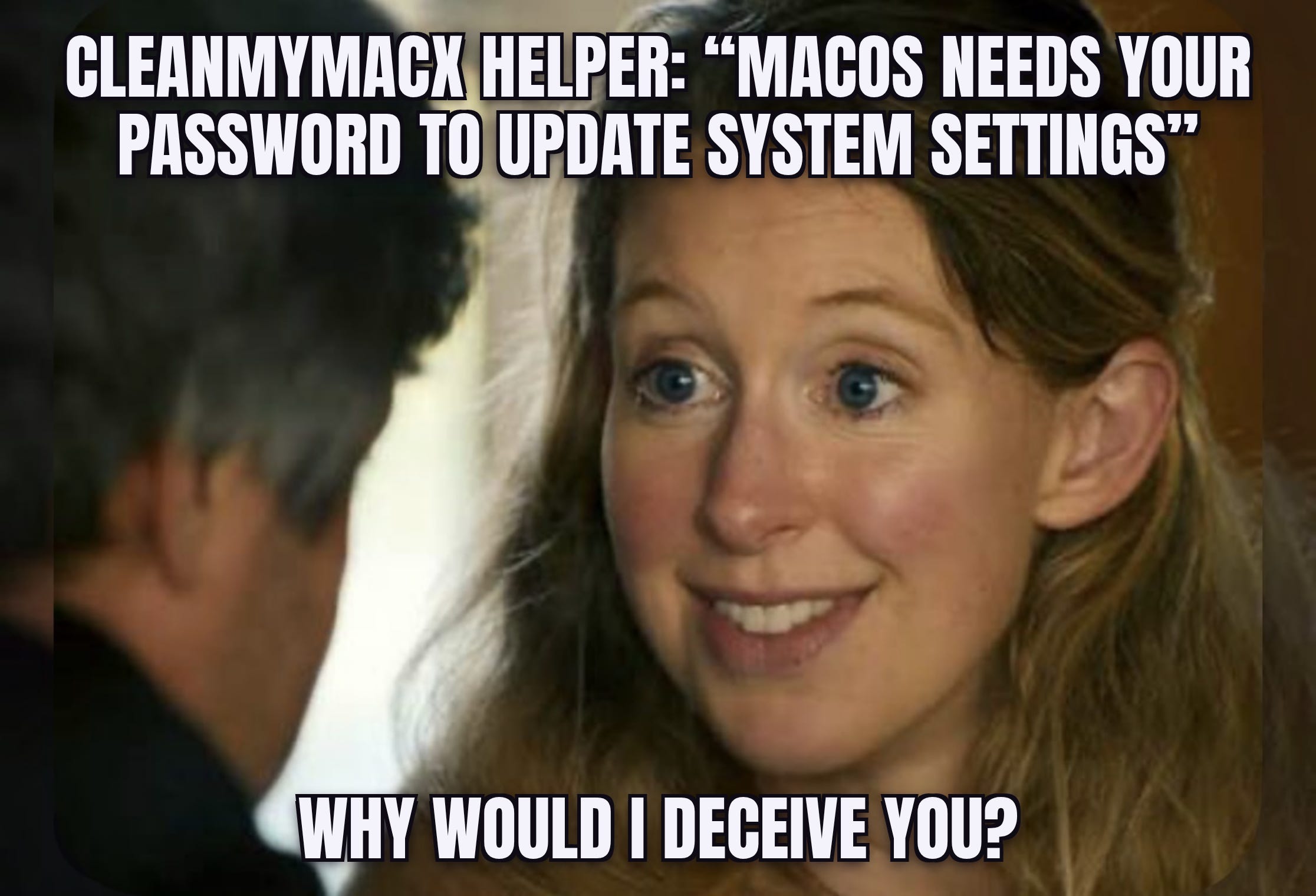
On MAC-DESIGN-01, AMOS arrives as an ad-hoc signed app called CleanMyMacX Helper. It borrows Apple’s osascript to pop a fake prompt (”macOS needs your password to update system settings”), opens the login keychain, and sends 2.45 MB to gateway.macos-analytics[.]top.
On MAC-DEV-01, DPRK’s BeaverTail comes in through a fake job interview. The developer runs npm install on a rigged package, postinstall.js runs node from inside node_modules, and the host beacons to api.ipcheck-beaver[.]cc.
On MAC-IT-01, CloudMensis-style persistence never touches the network. A hidden helper in /Users/Shared writes a LaunchAgent called com.apple.cloudsyncd.plist, and macOS logs a BTM launch item add.
Hunt these by process name and every one looks fine, because somebody named them to look fine. The LaunchAgent claims to be Apple’s, but it isn’t a platform binary and carries no Apple team ID. CleanMyMacX Helper is ad-hoc signed with an empty team_id. Signing identity exposes both.
osascript and node are the harder cases, because they’re legitimate binaries. For osascript the useful question is who launched it, and here that’s an unsigned app. For node it’s what the process was told to run. That’s ancestry and argv work.
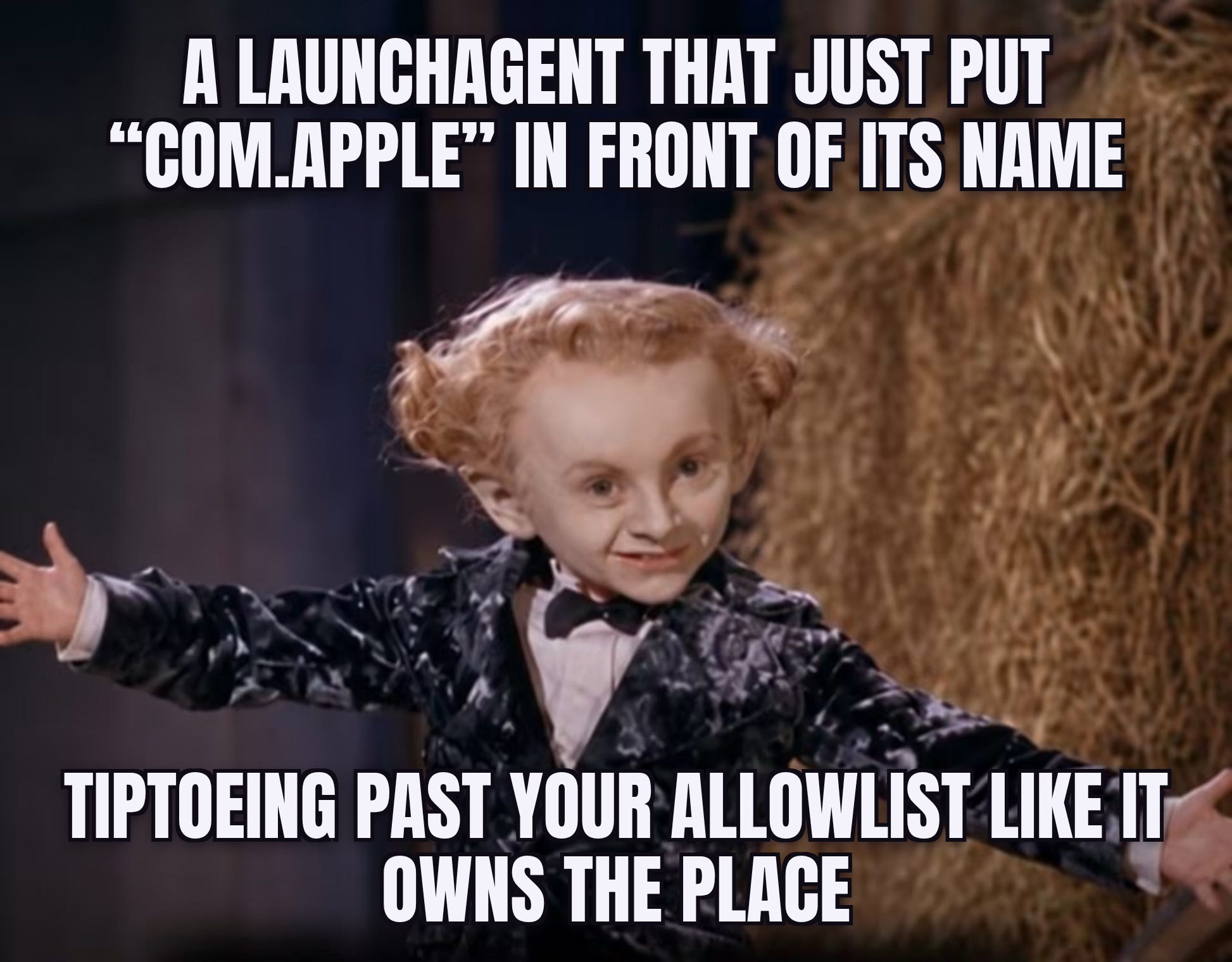
If your allowlist trusts anything named com.apple, this is what walks in.
On macOS a process name is a string the attacker picked, and the signature is much harder to fake. Start with signing_id, team_id, and is_platform_binary, then walk the ancestry.
Detection rules can ask the same questions. macOS coreSigma, which Eric Brown built at Nebulock, lets you write Sigma against ESF data and convert it for Elastic, Splunk, and other backends, and its macos_esf_ecs pipeline maps SigningID and TeamID onto ECS code signature fields. Here’s the rule for the AMOS prompt, trimmed to the detection logic. It can match osascript by its signer.
logsource:
  product: macos
  category: process_creation
detection:
  selection_process:
    Image|endswith: /osascript
  selection_signed:
    SigningID: com.apple.osascript
  selection_cmd:
    CommandLine|contains:
      - hidden answer
      - hiddenAnswer
  condition: (selection_process or selection_signed) and selection_cmd
coreSigma 2.0 came out on November 13 with 55 ESF rules, 20 Unified Log rules, and 7 correlations.
What memory bought us
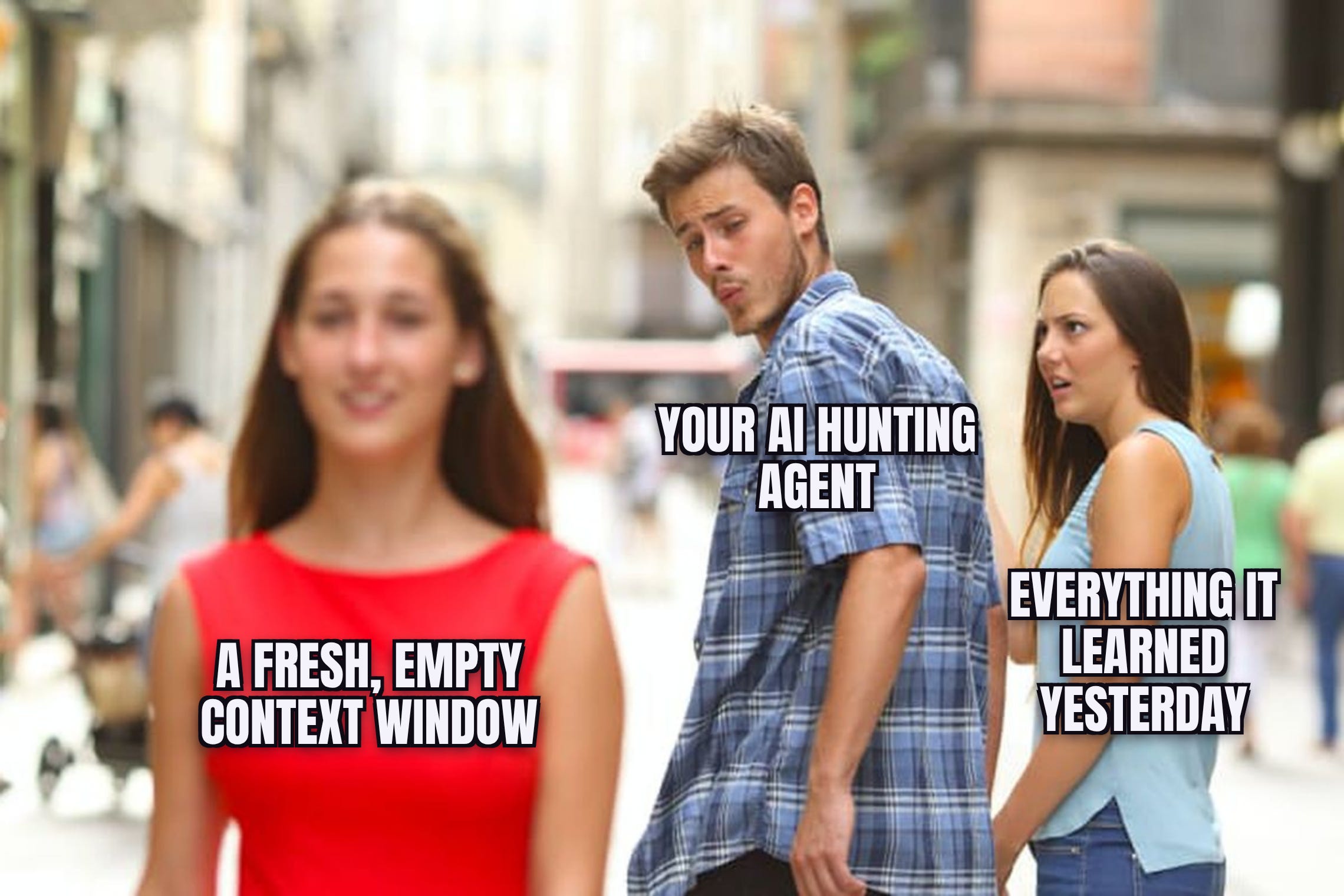
The agent was Claude Code working inside ATHF, the Agentic Threat Hunting Framework Sydney released last December to give hunting programs a memory. ATHF runs each hunt through a loop called LOCK (Learn, Observe, Check, Keep). Keep writes the hunt to an H-XXXX file, and on the next run the agent can find that work with athf hunt search and athf similar. Most AI hunting tools skip that step and start cold every morning.
We gave it one hypothesis, “unsigned or ad-hoc signed code is executing or persisting on our macOS fleet,” and no access to the answer key.
Run one, H-0004, started with nothing. In about six minutes it mapped six Macs, found all three intrusions, ruled out Homebrew, Chrome, and bcrypt, and kept 12 queries and 2 alert rules. Graded against the answer key in our November 11 rehearsal (EvidenceForge v2.2.0, seed 42), that came to 3 of 3 intrusions, 5 of 5 red herrings ruled out, and zero false positives. It also cleared three lookalikes that aren’t in the answer key at all.
It wrote one line about BeaverTail that we keep coming back to: “the script is unsigned code running under the signed node binary, so a signer filter alone can’t see it.” That’s the agent spotting where its own hypothesis runs out.
Run two, H-0005, started from run one’s memory. Its first query checked whether anything had changed since H-0004. Nothing had, so it didn’t redo the work. It went after cdhash, file ownership, whether a binary had been signed deliberately with codesign -s - or by the compiler, and a root-owned helper planted months earlier. It finished with two new rules that return only the malware.
Both runs took about six minutes. The second spent them on harder questions.
It also left itself a Keep note we’d hand to any human hunter. Run H-0004‘s first query, and if the counts match, read the old hunts before you hunt again. Plenty of human hunt teams don’t write down what they ruled out, and they pay for it the same way an amnesiac agent does.
What this does and doesn’t prove
We’d rather say this before the comments do.
It’s one dataset, one seed, and a handful of runs. We built the data and wrote the answer key, so we’re grading our own exam. The agent never saw the key, and anyone can rebuild seed 42 and check our numbers, but it’s still a small sample from interested parties.
The hypothesis also pointed in a helpful direction. All three intrusions involve unsigned or ad-hoc signed code, so “go look for unsigned code” was a generous place to start. The agent still had to sort out Homebrew, Chrome, and bcrypt, set aside five red herrings, and work out that BeaverTail was hiding under a signed node, so it wasn’t handed the answers. A vaguer hypothesis is the harder test, and the obvious next one to run.
Six Macs isn’t a fleet. Synthetic data only holds the weirdness the generator models, and real environments are weirder than any scenario file. Memory brings its own failure mode, too. If the environment changes and the agent trusts last week’s notes, it’ll skip work it needed to redo. Run two’s first move, checking whether the counts still matched, is the guard against that.
What it does show is narrower and, we think, more useful. If you only score an agent on whether it found the bad thing, both runs get the same grade, because both found 3 of 3. The difference shows up in what the second run built with the same six minutes: deeper analysis and two rules precise enough to ship. Anyone evaluating agentic hunting should measure what the agent produces over time alongside what it catches, or memory will look worthless on paper.
Determinism also turns this into a regression test. Change a prompt, a rule, or the model, rebuild seed 42, rerun the hunt, and diff the hunt files. We’d want that test before letting any change to an agent near production data.
Rerun it yourself
Everything is open source:
EvidenceForge: github.com/Cisco-Talos/EvidenceForge
macOS coreSigma: github.com/Nebulock-Inc/macos-coresigma
ATHF: github.com/Nebulock-Inc/agentic-threat-hunting-framework
The scenario, rules, and hunts from the talk: github.com/THORCollective/obts-hunting-with-agents
Rebuild seed 42 with EvidenceForge and you’ll get the exact dataset we hunted, answer key included. Point coreSigma’s rules at it, then set up ATHF:
pip install agentic-threat-hunting-framework
athf init
Run a hunt, let Keep build up some memory, and run it again. When a hunt holds up, Alex Hurtado’s GATES method, which ships as a skill in ATHF, helps decide whether it should become a detection. ADEF, ATHF’s detection engineering sibling, gives each detection a lifecycle and a journal of why it exists.
For years the honest answer to “how do I practice macOS hunting?” has been “carefully, and not very often.” We think that’s changing. Rebuild the dataset, hunt it, and tell us where it breaks. If you write a hunt that holds up, add it to HEARTH, THOR Collective’s community library of hunt hypotheses.
Thanks to Cisco Talos for EvidenceForge and to Eric Brown for coreSigma.