

There is a particular kind of satisfaction that comes from building something. Not buying it. Not configuring it. Not asking someone else to make it for you. Building it yourself, out of raw materials and stubborn intention.
Ask any artist and they can tell you about this feeling. A painter staring at a blank canvas. A musician sitting down with an instrument and an idea that does not have a shape yet. A writer wrestling with a sentence until it finally says what they meant. Building is an act of defiance against the void. You looked at nothing and decided something should exist there.
Security practitioners are not taught to think of themselves this way. We are taught to defend, detect, respond, contain. We are positioned as reactors to someone else’s creativity. Usually the attacker’s creativity, but sometimes that of our fellow security practitioners. They build the malware, the phishing kits, the persistence mechanisms. We clean up after them. But that framing is a trap. And it is time to walk out of it.
Here is a phrase that has held back more security practitioners than any technical limitation ever could: “I am not a developer.”
It sounds humble. Reasonable, even. But it is not humility. It is a cage we built for ourselves and then handed someone else the key. The phrase contains a hidden assumption: that building requires a credential, a pedigree, permission from some gatekeeping authority that decides who gets to create.
That was never true. And it is less true now than it has ever been.
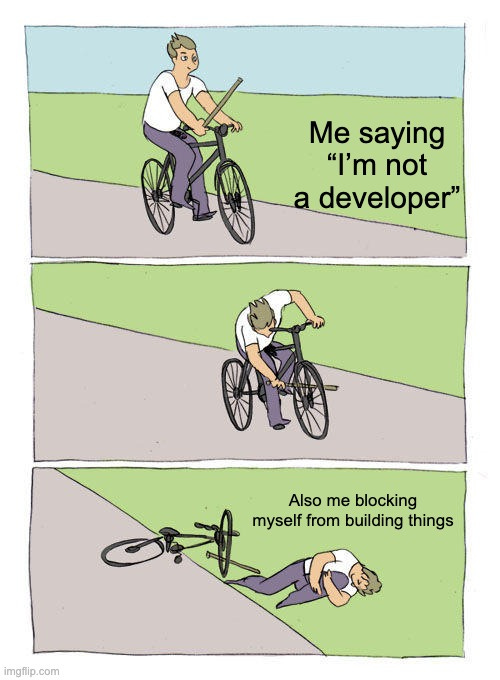
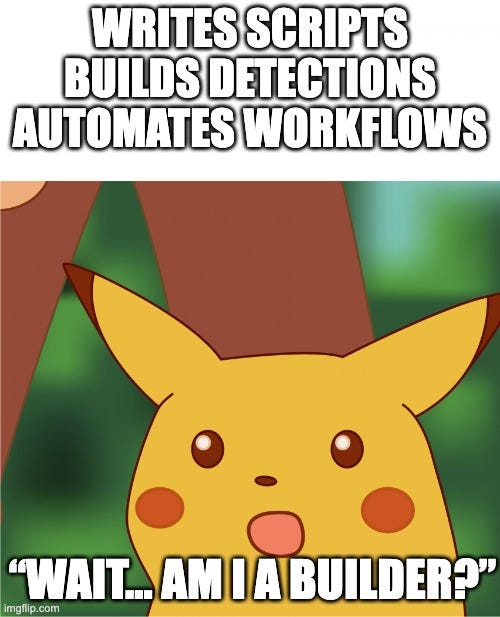
In fact, many of you are already building and don’t even realize it. That query you wrote to catch something your SIEM vendor did not account for? That is building. The spreadsheet you rigged together to track cases because the ticketing system did not fit your workflow? Building. The ugly PowerShell script you are vaguely embarrassed about but still use every week because it works? That is building too. You didn’t wait for permission. The only difference between that and what you think of as “real” building is scope and the story you tell yourself about what counts.
Think about how much of your daily work is shaped by tools someone else made. Tools that reflect someone else’s assumptions about what you need, what workflows make sense. You adapt to them. You work around their limitations. You file feature requests into a queue with 50,000 other requests and hope someone, someday, prioritizes your problem. Now think about what it would mean to shape your own environment instead. To look at a friction point and remove it. To stop asking and start making.
Artists understand this intuitively. A painter does not wait for someone to hand them the exact painting they wanted to see. They make it. They impose their vision on the world. You can do the same thing with a script, a detection, a dashboard. The medium is different. The creative act is the same.
Not everything you build needs to be ambitious. In fact, the most transformative building often happens at the smallest scale. A script that saves ten minutes, a query that surfaces signal you were missing, a playbook that cuts an investigation in half. These things compound. Each one is evidence that you can shape your environment, not just react to it. And small creations teach you how to make bigger ones. Every artist starts with sketches. The goal is not perfection. The goal is momentum.
What you create belongs to you. Not in a legal sense (though sometimes that too - IANAL - consult your hiring agreement). In a deeper sense. The understanding you gain by building cannot be taken away. The skill stays sharp. The confidence you earn from watching something work that did not exist before you made it, that is yours forever. Vendors come and go. Tools get deprecated. Budgets get cut. But the builder’s mindset travels with you. It is not tied to any platform or employer. It compounds over a career.
You do not need to be a developer. You do not need permission or the perfect idea or the perfect afternoon with no meetings. You just need to start—or to recognize that you already have.
The canvas is blank. What will you make?
*This is the second piece in a series on building as a core security skill. Previously: “2026: The Year Builders Show Up.”*