

You don’t need permission to teach the thing you know. You need a scope, a plan, and the courage to hit submit.
You’ve had the idea. Maybe for a while now.
You’ve thought about it, talked yourself out of it, told yourself next year, or decided that someone more qualified should be the one to do it.
They shouldn’t. You should.
This post exists because the gap between knowing something and believing you’re allowed to teach it is real, and it stops good proposals from ever getting written. We want to help you write yours.
The Imposter Syndrome Trap Is a Specific Lie
The thought sounds like: “Someone else knows this better than I do. Someone more qualified should be the one teaching it.”
Here’s what makes that thought dangerous: it’s technically unfalsifiable and practically infinite. There will always be someone who has been doing this longer. That doesn’t make your knowledge less real or less useful. It just means you have more to learn, same as everyone in the room, including the person you think is more qualified.
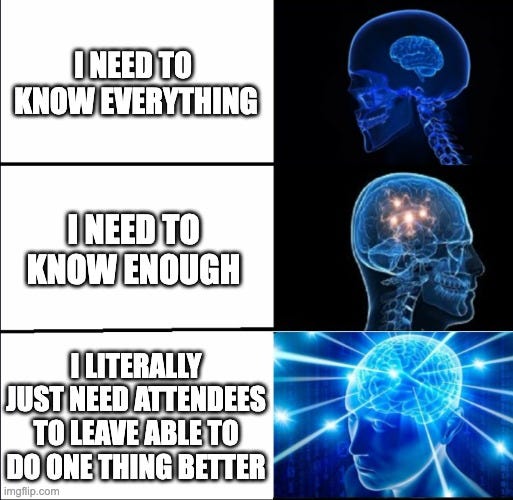
The bar for teaching a workshop is not “know everything.” The bar is “know enough more than your attendees to take them somewhere they couldn’t get to on their own.” That bar is almost certainly lower than imposter syndrome is telling you it is.
A simple test: think about the last time a colleague asked you to explain something. Think about the workaround you figured out that nobody else on your team knew existed. Think about the presentation where you thought “they skipped the part that actually matters.”
That’s your workshop.
Some of the best workshops start as “here’s the weird thing I had to figure out at work.”
That moment of “wait, I actually know this” is the seed of a proposal.
If you’re still not sure, ask three people in your network what they’d most want to learn from you. The answers will probably surprise you.
How to Scope a Workshop Topic
Most proposals collapse at this step, not because the idea is bad, but because it’s too wide.
The talk version of your idea tries to cover everything. The workshop version picks one thing and goes deep.
A talk might be “Introduction to Memory Forensics.” A workshop is “Analyzing LSASS Dumps to Identify Credential Theft: A Hands-On Lab.” See the difference? The workshop has a specific destination. Attendees know exactly what they’re walking out able to do.
Scoping test:
Write down what you want attendees to be able to do by the end. Not “understand X,” do Y.
Draw a box around it. Smaller than you think. Now smaller again.
Ask: can someone complete this in 90 minutes to three hours with a laptop and a pre-built environment?
If yes, you have a workshop scope. If no, cut it.
Tight scope delivered well beats ambitious scope delivered poorly every time. Attendees leave a focused workshop feeling like they actually got something. They leave an over-scoped one feeling like they missed most of it, and they’ll be right.
The other scope question is logistics. Does your attendee need a VM? A cloud sandbox? A pre-loaded dataset? A browser? Nothing? Work that out early. A lab environment that 40% of the room can’t access will derail an otherwise excellent workshop faster than anything.
The Format Is More Forgiving Than It Looks
The proposal is not a thesis defense.
You need to describe the topic, the target skill level, what attendees will leave able to do, and what environment or materials they’ll need. That’s it. Reviewers are looking for clarity of intent, not polish.
What is this workshop?
Who is it for?
Will people walk out with a concrete skill or artifact?
If you can answer those three questions in plain sentences, you can write a proposal.
You also don’t need a fully built-out lab to submit. You need a plan. The lab gets built after acceptance. The proposal is the idea.
And nerves are normal. They don’t go away with preparation, but preparation changes what they feel like. Instead of “I don’t know if I can do this,” they become “I really want this to land.” That is a useful kind of nervous.
The first five minutes on stage are the hardest. After that, once the first question comes in and someone runs the first command and gets a result, it stops being a performance and starts being a conversation. That’s when the room becomes yours.
The audience wants you to succeed. They chose your workshop over every other option in the schedule. They showed up because they already believe what you’re offering is worth their time.
The Community Is Better When More of Us Teach
When the people teaching are a narrow slice of the people doing the work, the content reflects that. Knowledge that lives in different parts of the community, different environments, different tooling constraints, different perspectives, doesn’t make it into workshops because the people who could teach it never submit.
That’s a loss for everyone in the room.
The downside of submitting and not getting accepted is a rejection email.
The downside of not submitting is that your workshop doesn’t exist, and neither does the community that would have formed around it.
Before You Close This Tab
Open the CFP. Not to submit today. Just to open it.
Quick-start checklist:
Name the thing you’d most want to teach. One topic, two sentences.
Identify the specific skill attendees will leave with. Not “they’ll understand X,” “they’ll be able to do Y.”
Write down what environment they’ll need (VM, browser, dataset, nothing).
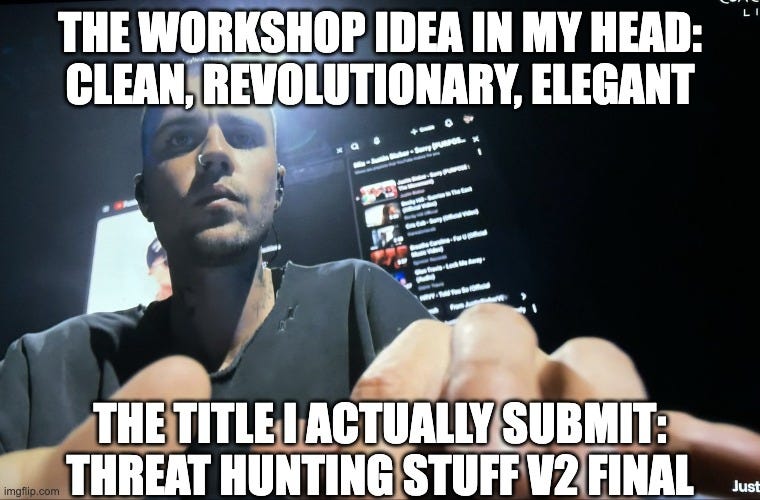
Draft a title. It doesn’t have to be good. It has to exist.
Open the CFP form and put your two sentences in it.
That’s the first step. Everything else you can figure out after you’ve decided to do it.
Your idea deserves a room. Give it one.
And if you happen to be looking for a place to start, DEATHCon’s CFP is currently open.